
PPS+ or PPLNS: The Choice That Shapes Your Cash Flow
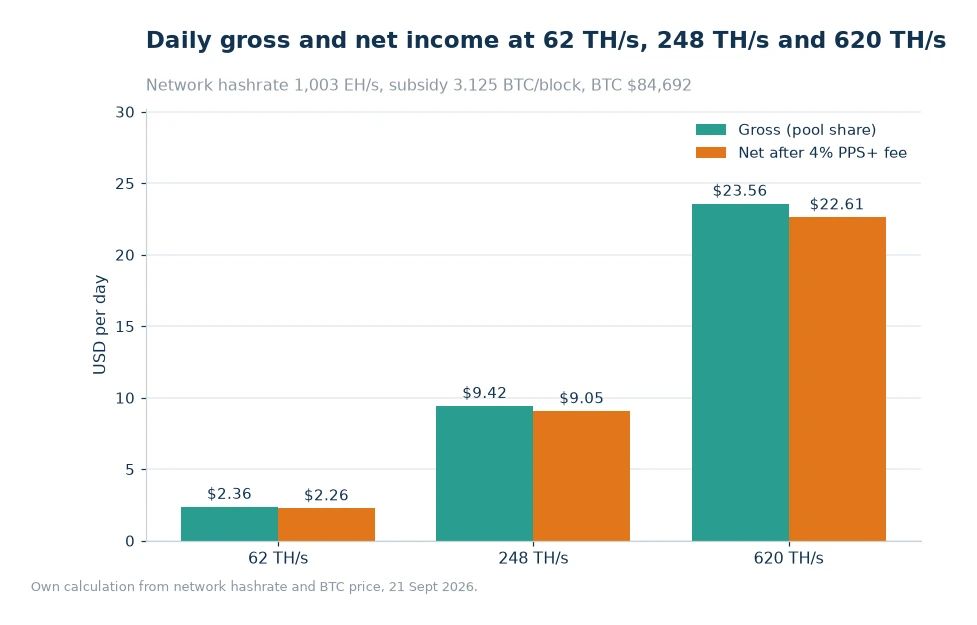
Both payout schemes pay for the same shares; they differ in when the money arrives and who carries the luck. At 62 TH/s the gross is $2.36 a day, $2.26 under PPS+ after the listed 4% on the block-reward component, and about $2.31 under PPLNS at its listed 2% — except that the PPLNS figure is an average, not a schedule. A miner with a monthly power bill should care about that distinction as much as about the fractions.

Key takeaways
- PPS+ settles hourly against current difficulty, so 62 TH/s credits roughly $2.26 every day without waiting for a block.
- PPLNS pays after 6 confirmations and averages the miner's share over the last 5 difficulty rounds.
- The PPS+ listed rates are 4% on the block-reward component and 2% on the transaction-fee component; PPLNS lists 2% on both combined.
- Withdrawal of mining income carries no fee, so scheme choice is about timing and variance rather than exit costs.
Same shares, different clock
Under PPS+, the block-reward side of the payout is settled against the current difficulty and credited every hour. The pool absorbs the variance of block discovery, and the miner receives a steady drip that can be forecast from hashrate alone. Under PPLNS, nothing arrives until a block is found and confirmed six times, after which the miner's slice of the last five difficulty rounds is paid out in one movement.
Read those two sentences again and the trade becomes obvious. One scheme sells certainty and charges for it. The other keeps the fee lower and hands the miner a share of the randomness. Neither is generous or stingy in the abstract; they sit at different points on the same risk-return line, and the right point depends on what the operator needs from the account this month.
What 62 TH/s produces under each
At 1,003 EH/s of network hashrate and a 3.125 BTC subsidy, 62 TH/s mines 0.00002781 BTC a day, worth $2.36 at $84,692. Apply the listed 4% to the block-reward portion and the credit drops to $2.26. Apply the PPLNS listed 2% to the combined reward and the long-run average sits near $2.31, with actual days scattered above and below it depending on how the pool's blocks land.
The gap between $2.26 and $2.31 is five cents a day, about $1.50 a month at this size. That is the entire price of certainty at 62 TH/s, and it is small in absolute terms. At 620 TH/s the same five-cent gap becomes fifty cents a day, and the calculation starts to matter enough to justify a spreadsheet rather than a guess.
Why the five-round window changes the shape
PPLNS does not average over calendar time; it averages over the last five difficulty rounds of shares submitted to the pool. That window is why a miner who joins mid-round is not penalized for the blocks found before arrival, and why a miner who leaves is not paid for rounds that finish after departure. It also means the effective rate depends on how consistently the machine submits shares, not just on the nominal hashrate.
Difficulty rounds themselves last about two weeks at current conditions. Five of them is roughly ten weeks of history, which is long enough to smooth most of a month's noise but not long enough to make any single payout predictable. If the pool finds fewer blocks than expected in the window, the PPLNS average falls; if it finds more, the average rises. The listed percentage does not change either way.
Matching the scheme to the bill
Households and small farms usually pay for power on a fixed date, which makes a fixed income easier to plan around. A 62 TH/s unit on PPS+ credits $2.26 a day and can be checked against the power cost line by line. On PPLNS the same unit might credit nothing for three days and then a lump that covers the gap, which is fine for the annual total and awkward for a quarterly budget.
Operators with a cash buffer can take the other side of that trade deliberately. Accepting variance in exchange for the lower listed rate is a rational position if the reserve covers two lean weeks and the power contract is already paid. It stops being rational when the buffer is a credit card.
Checking the claim after the switch
Whichever scheme is selected on ViaBTC Crypto Mining, the first month should be audited against the numbers that were promised. Compare the daily credit at your hashrate with the arithmetic in the worked example below, and watch whether the pool's own hashrate is holding its share of the network. A pool that grows quickly dilutes each miner's slice of a fixed issuance, so a flat daily credit alongside a rising network is a sign the machine is falling behind rather than a sign the pool is cheating.
The fee schedule states each rate against the component it applies to, which is the detail most comparison tables omit. Read it before switching, then re-read it after a month with the statement open. Switching schemes is cheap; switching on a misunderstanding of which component carries which fee is expensive in time.
Where the two schemes diverge
The table sets the schemes side by side on the four points that actually change an operator's month. Percentages are the listed ones, and the dollar figures use the 62 TH/s tier from the chart.
| Question | PPS+ (default) | PPLNS |
|---|---|---|
| When is income credited? | Hourly, against current difficulty | After 6 confirmations on each block |
| Which rate applies? | 4% block reward, 2% transaction fees | 2% on both combined |
| Who carries pool luck? | The pool | The miner |
| Daily value at 62 TH/s | $2.26, steady | About $2.31 on average, uneven |
Worked example
Start from the network total and work down to both scheme values at 62 TH/s.
- The per-terahash rate is 450 ÷ 1,003,000,000, which equals 0.00000044865 BTC a day.
- 62 TH/s: 62 × 0.00000044865 = 0.0000278163 BTC a day.
- Gross dollars: 0.0000278163 × 84,692 = $2.3558, rounded to $2.36.
- PPS+ block-reward side at the listed 4%: 2.3558 × 0.96 = $2.2616, rounded to $2.26.
- PPLNS at the listed 2% on the combined reward: 2.3558 × 0.98 = $2.3087, or about $2.31.
- 248 TH/s, four times the tier: $9.42 gross, $9.05 under PPS+, $9.23 under PPLNS at the average.
- 620 TH/s, ten times the tier: $23.56 gross, $22.61 under PPS+, $23.09 under PPLNS at the average.
Frequently asked questions
Which payout scheme pays more at 62 TH/s?
On the listed rates, PPLNS averages about $2.31 a day against $2.26 under PPS+, because its 2% applies to the combined reward; the PPS+ figure arrives hourly and does not swing with pool luck.
How long does PPLNS take to pay after a block?
Six confirmations. Once the block reaches that depth, the miner's share of the last five difficulty rounds is calculated and paid, so the delay depends on block times rather than on a fixed clock.
Can a miner switch schemes without moving hardware?
Yes. The scheme is an account setting tied to the payout address and worker name, so the same machine can change settlement method while its shares keep flowing to the same pool.
Decide with a month of statements
Run the current scheme for a full billing cycle, note the daily credit next to the power cost, and only then compare it with what the calculator predicts for the alternative. One month is enough to see the shape of the cash flow and short enough to correct a mistake before it compounds. Choose the scheme whose worst week you can survive, then let the average look after itself.
Listed rates from the ViaBTC pricing page, 21 Sept 2026[1]; chain inputs then were 1,003 EH/s, 132.76 T difficulty, 3.125 BTC per block and $84,692 per BTC. Published 24 Oct 2026. PPLNS averages are arithmetic on the listed rate and assume steady share submission.